Wednesday, January 23, 2013

Decanting Wine – Is it Necessary?


Decanting is something some wine lovers enjoy doing, while others like to debate the pros and cons.  Does it matter?  It seems everyone has an opinion.

When you decant a wine, you pour it (decanting) into another container (decanter) for two reasons; to filter off the sediment so the wine is not gritty or bitter, and/or to allow it to ‘breathe’ by mixing air with the wine to liven up it’s flavors and aromas.

Decanting for Sediment -
Most young wines sold today in the US, do not need to be decanted for sediment.  The winemaking process clarifies and filters wines before they are bottled.  However, some ‘natural’ wines may contain sediment since they are not filtered in any way before bottling. White wines that are unfiltered will appear cloudy or hazy in appearance.

Older red wines, like Cabernets, Zinfandels, Syraz, and Ports, may have sediment, which occurs naturally as certain wines age.  Sediment may be found in the bottom of the bottle and looks like mud, or thick grit.  Removing this before serving will make the wine presentation much nicer and also help eliminate the dry, bitter flavors that come from the sediment.

How:
Decanting a wine is not difficult, regardless of what you may have read, or been told.  Some wine lovers use special equipment such as a wine cradle and candle, but all you really need is a steady hand and another container (decanter) to pour the wine in.


Begin by letting the wine bottle stand upright for two or three days so the sediment goes to the bottom.  Pour the wine slowly into another container.  When the sediment begins to gather in the shoulder and neck of the bottle slow the pour even more, allowing sediment more to gather there.  The wine bottle is actually made to catch this sediment when the wine is poured slowly.

Decanting for Aeration -
When you aerate a wine, you are allowing air into it.  This is also known as allowing it to ‘breathe.’  The air allows the release of more aromas and flavors.  It is said that aeration also allows the tannins to ‘soften’, but that is debated in the industry.  The wines that benefit most from aeration are, again, the heavy reds like Cabernet Sauvignon, Syrah, Zinfandel, and Port.

Aeration may help a young, lackluster wine by brightening the taste.  It may also help a wine that has a slight, unappealing order.  This can be a common problem with ‘natural’ wines.  After allowed to breathe, these wines may become more palatable. If they become worse, dump the bottle as it may be corked.

How:
To aerate a wine, simply pour it from the bottle into a decanter.  This does not need to be a special wine decanter, but simply a container with a wide bottom that will allow the surface air to mix with the wine.  Just pulling the cork will not allow enough air to reach the wine in the bottle. 

Decanting times vary depending on the wine.  For a young wine, let it breathe for 20 minutes, up to an hour.  For an older wine, try 10 or 15 minutes. The longer an older wine aerates, the more the flavors can deteriorate. Vintage Ports may be allowed to ‘breathe’ longer.

If you’re not sure how long to aerate, check the wine by pouring a splash into a glass and tasting it every 15 minutes.  Aeration is supposed to liven up the wine, making it taste more vibrant, more flavorful.  Just be careful not to decant for too long because the flavors can disappear.

Remember, most wines are to be consumed within a couple of years of their release.  While aeration might help them, it is not mandatory.  The best way to find out is to experiment.

In the end, the decision to decant is best made according to each bottle.  Decanting for sediment makes sense to avoid a mouthful of bitter grit.  Aerating a wine is more of a personal preference.  If you find that you enjoy a certain wine more when it’s decanted, then feel free to do it.  If you really can’t tell the difference, then don’t worry about it.  Wine is meant to be enjoyed, so forget the “rules” and enjoy it the way YOU like it!!

~ Joy

Wednesday, January 16, 2013

The “Noble Experiment” Begins – Prohibition

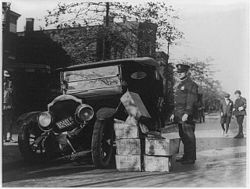
Ninety-three years ago today, Prohibition became law in the United States. And as a result, the country would never be the same.

On January 16, 1919, the 18th Amendment was added to the US Constitution, and one year later it was put into effect.  It had taken two years of diligent work by the Senate, the House, numerous religious groups, the Anti-Saloon League, and 36 states before Prohibition was enacted.
 
It was President Herbert Hoover who called Prohibition "The Noble Experiment," because some felt it was a way to attempt to keep families together, while doing away with alcohol abuse.  Prohibition was considered an experiment because those in the larger cities saw nothing wrong with drinking in moderation.

Prohibition called for a nation-wide ban on the manufacturing, transportation, and sale of alcohol.  This included wine, beer, and spirits – any alcohol over 0.5% by volume.  But it did not outlaw the possession or consumption of alcohol.  The Volstead Act was enacted in order to achieve this.  But there were still loopholes in the laws.


One such omission allowed pharmacists to legally dispense alcohol by prescription.  It didn’t take the criminal element long to figure out that owning a pharmacy was the perfect façade to bootleg liquor from.


 Another loophole allowed wine to be obtained and used for religious purposes. Self-ordained ministers and rabbis suddenly appeared to purchase wine for their ‘congregations’ across the country.


Prohibition was brought about to curb excessive drinking and loose morals, while touting the increased economic effects that would result.  Some predicted that this “noble experiment” would not go well.


This ban on alcohol had been tried before – on a smaller scale.  In 1844, a Massachusetts town had made the sale of alcohol illegal.  This led one tavern owner to then charge admission to customers to see a striped pig in his saloon.  Once inside, drinks were provided for ‘free.’

The state of Maine became the first state to ban the sale of alcohol in 1851.  The state’s Irish population and those of the working class revolted.  By 1855, opinions had seethed until a deadly riot broke out in Portland.  The law was quickly repealed.

Proponents of Prohibition were sure that once the sale of alcohol was banned, people would become more moral and family–oriented. Health issues were expected to improve. Supporters believed that the economy would get better because workers would become more productive and many men would stop spending all of the family’s money on drink. Crime rates were expected to decrease dramatically.

Instead of bringing about these conditions, Prohibition was a fiasco.  Besides the loss of billions of tax dollars, thousands who had worked in the alcohol industry immediately lost their jobs when distilleries, wineries, breweries, and saloons closed.  Restaurants began to fail when they could no longer make a profit from the sale of alcoholic drinks.


Prohibition cost the Federal Government $11 billion dollars in lost revenue from the excise taxes on alcohol sales.  States that relied on excise liquor taxes to fund them, suddenly and completely lost that income. (The State of New York derived almost 75% of their budget from these taxes – and it was gone, overnight.)  With an eye toward getting more money in the coffers quickly, income taxes were enacted and became the new way to fund state and the Federal budgets.  (And, interestingly, were never done away with after Prohibition was repealed…) It appears no one took into account the cost to enforce Prohibition – which grew to over $300-million dollars.

Millions of Americans became criminals, thanks to Prohibition.  Moon shiners cropped up all over the country, taking grain and distilling it into corn mash and hooch to be sold. Bootleggers smuggled homemade alcohol to those who wanted it, for an outrageous price. Many people attempted to make their own wine at home by following the ‘warning’ labels attached to jugs of concentrated grape juice. These labels described what not to do to cause the juice to ferment and become wine.

Organized crime was now thriving in major cities such as Chicago and New York, thanks to Prohibition. With the passing of the 18th Amendment, alcohol sales went underground.  Speakeasy clubs sprang up in all major cities. Operated by gangsters, these illegal clubs allowed entry to anyone who knew the password or secret knock.  Once inside, a customer could enjoy illegal drinks and socialize with like-minded people.

In New York alone there were reports of between 30,000 to 100,000 speakeasies in business by 1925. With only 1,500 Federal Prohibition agents to enforce the new law, vice spread quickly throughout the country.


Prohibition also brought about health issues.  Now that alcohol was unregulated, black market hooch could be contaminated with acetone, antifreeze, various aldehydes, or by the coils used in the stills, which contained lead or glycol. It was estimated that over 1,000 people died every year during Prohibition from drinking impure and harmful alcohol.


By 1933, lawmakers were ready to admit that the Noble Experiment had been anything but noble.  After almost fourteen years, the 18th Amendment was abolished, making alcohol legal again.  This is the first and only time an amendment to the US Constitution has been repealed.


So tonight, pour a glass of your favorite wine, beer, or spirit, and toast the fact that the right to drink alcohol is a personal decision and not one controlled by a national or state law.

Cheers! Prohibition is no more!

~ Joy

Wednesday, January 2, 2013

Do Your New Year’s Resolutions Include Starting a Winery?


With the new year comes New Year’s resolutions – a chance to change what you didn’t like about the past year, and to focus on new personal growth, a new job, or new, exciting plans for the future.


Maybe this will be the year you get to travel; to move into the type of home you’ve always wanted, have the chance to start a family, begin a new career, or become your own boss. I was thinking of resolutions and new starts when I stumbled upon several websites encouraging people to start their own wineries with phrases like “Romantic endeavor”, “Exciting business”, “Become a wine expert”, “Rewarding lifestyle”.


Now, don’t get me wrong – being a winery owner can be romantic, exciting, and rewarding, as these sites suggests; but it can also be time-consuming, full of mountains of paperwork and forms, (TTB, state, and county tax paperwork that needs filed every month, every quarter, and every year.) And, if you’re thinking this is a way to make quick, easy money, keep in mind the old adage; “How do you make a small fortune in the wine business?  Start with a large one.” 

Consider:
While I love dealing with the customers, teaching those new to wine the basics of tasting, and helping them find what they like; owning a winery is not all a chilled glass of well-oaked Chardonnay.  You’ll be investing your time, your money, and your life in this endeavor - for years.

Why?
If you want to own a winery so that you can drink all of the ‘free’ wine you want, (Yes, I’ve actually heard this!)  – This is sooo not the industry for you.  You, as a winery owner, should be setting an example by not drinking too much.  And there is no such thing as free wine – it all must be accounted for to the TTB, and other agencies; even the wine that you loose, dump, or pour out.


If you don’t like writing and doing paperwork, don’t consider owning a winery. Besides the above-mentioned alcohol agencies and their various tax forms, you’ll be filling for licenses for the federal, state, and possibly county or city/township level.  You’ll also have the USDA Census of Agriculture to complete, plus various state agriculture and wine surveys to fill out.  You’ll need to keep up-to-date tasting notes for your bar. Then there’s the marketing aspect of writing press releases on awards won, and how your wines and winery are faring in the wine industry, in general.  There’s also newsletters/wine club letters to write, social media to keep current, and your winery's wine blog that keeps in touch with your customers, and potential customers.

Please remember, this in NOT the business to get into to meet (fill in the blank)…. cool dudes, hot chicks, the rich and famous…  Believe it or not, this is a service business, just like a restaurant or a package delivery service. If you’re not here because you have a passion for wine and want to share it – Keep looking, there’s something else out there for you.


If you just love the ‘atmosphere’ of a winery – make sure you really understand what that atmosphere entails by volunteering at other wineries.  Yes - volunteering.  Find out if you really do love the real life-style.  Offer to learn everything you can, and remember, no job is too menial for you to do if you’re serious about owning a winery.  Learn how to clean tanks, help on the bottling line, sweep the floors, crush grapes, order for the tasting room, work the bar, organize winery events, and yes, scrub the bathrooms.  Those are all jobs you can, and usually do, end up doing when it’s yours.

What?
Now for the basic questions –
*  What types of wine do you want to craft?
* Do you know who your competition will be?
* What kind of winery do you want?  A winery with a vineyard - A retail winery - A winery with a restaurant?
* Will you be the winemaker, or do you have someone in mind? Do you know anything about making wine?  If not…
* Do you know how much it costs to hire a good winemaker?
* Will you do your own marketing?  Do you understand the necessity of marketing this business?
* Are you going to lease or buy the equipment?
* Will you hire employees, or contract labor, as needed?
* Do you plan to have your wines distributed to wine shops, grocery stores, and liquor marts for retail sales there? Do you know how to go about this?

There are hundreds more questions to consider, but you get the idea – this isn’t a business where you say, “I can do that, it sounds like fun,” without A LOT of serious thought.

Where?
And remember, when owning a winery – location is everything!  You need traffic to sell that wine – foot traffic, drive-by traffic, local traffic, tourist traffic, holiday traffic. Feet in the door equal money in the till.

Who?
If you’re serious, owning a winery can be one of the most interesting and exciting jobs in the world.  But start by learning the ropes.  Then find out who’s who in the industry at large, in your state, even in your city.  Join your state’s wine association and attend their meetings and annual conference.  Look for the national wine conferences also, like the Eastern Winery Exposition, www.easternwineryexposition.com and the Midwest Grape & Wine Conference, www.midwestgrape.com.  You’ll attend some great lectures, get a chance to ask questions, visit with exhibitors, and meet others who share your interest in wine, who can offer advice and suggestions.

And, these are just a few things to think about; we haven’t even touched on owning a vineyard (or getting your wines into distribution!)

Do your research.  Read up on the industry, and base your decisions on actual wine business statistics, advice from those in the industry, and in the end, your gut. YOU know if this is the right business for you.


Robert Mondavi said it best in his autobiography, Harvests of Joy:
“Wine to me is passion.  It's family and friends.  It's warmth of heart and generosity of spirit.  Wine is art.  It's culture.  It's the essence of civilization and the art of living.”

May you have a Happy New Year, and attain your dreams in 2013!!

~ Joy