 Thanksgiving
is a traditional, and federal holiday celebrated in the United States on the
fourth Thursday of November. The Continental Congress first declared the
National Proclamation of Thanksgiving in 1777. The days of Thanksgiving varied
from year to year but were celebrated with some regularity in the mid-17th
century after the harvest was in.
Thanksgiving
is a traditional, and federal holiday celebrated in the United States on the
fourth Thursday of November. The Continental Congress first declared the
National Proclamation of Thanksgiving in 1777. The days of Thanksgiving varied
from year to year but were celebrated with some regularity in the mid-17th
century after the harvest was in.
 |
| Lincoln |
But
it was in 1863, when President Lincoln proclaimed it a national holiday to be
celebrated the fourth Thursday of November each year that Thanksgiving began to
become a treasured holiday.
 The
Pilgrims celebrated the first Thanksgiving in 1621 at what is now the Plymouth
Plantation. The three-day feast was held after the first successful harvest in
the New World. Over fifty Pilgrims and
90 Wampanoag Indians attended the celebration.
The
Pilgrims celebrated the first Thanksgiving in 1621 at what is now the Plymouth
Plantation. The three-day feast was held after the first successful harvest in
the New World. Over fifty Pilgrims and
90 Wampanoag Indians attended the celebration.
 |
| Deer |
The
foods of the first Thanksgiving vary somewhat from what we have today. The Pilgrims did have access to wild turkeys,
but there was also venison, eel, cod, bass, and waterfowl available.
 |
| Autumn Vegetables |
The
vegetables that were available included corn, onions, leeks, carrots, cabbage,
various squash and pumpkins; nuts, dried fruits, cranberries, and apples were
also included in the feast.
 |
| Thanksgiving Dinner |
In
modern times, our Thanksgiving usually includes what has become traditional
foods; turkey, dressing/stuffing, mashed potatoes, sweet potatoes, gravy,
cranberry sauce, autumn vegetables such as corn, beans, squash, and pumpkin
pies. The choice of beverage usually includes tea, coffee, colas, wine, and
beer.
 |
| Mayflower |
But
has wine always been a Thanksgiving staple?
According to information regarding the cargo carried by the Mayflower –
wine was regularly included on its shipping routes. The Mayflower’s hold could
carry 180 oak casks of wine and was typically loaded with wines from Bordeaux
and La Rochelle, France to be shipped back to England.
 |
| Hard Cider Casks |
Wine
was also listed in supplies sent to the New World from England, along with
beer, aqua vita, (a drink made from distilled wine or beer) and hard
cider. As the colonists learned how to
make these beverages in America, they began to disappear from the shipping
supply roles. While native grapes, fruits, and grains would have changed the
taste of the wines, beers, and hard ciders, colonists learned how to work with
them to craft flavorful beverages to be enjoyed with their meals. By the mid-1600’s, hard cider was the drink
of choice in the colonies.
 |
| Wine with the Bird |
Today,
there are many wines touted as excellent Thanksgiving wines – Pinot Noir,
Zinfandel, Sauvignon Blanc, Riesling, Gewurztraminer/Traminette, and sparkling
wines like a Moscato, to name just a few.
 |
| Georges Duboeuf |
Georges
Duboeuf knew that Beaujolais would pair wonderfully well with the normal autumn
celebration fare, but this wine was traditionally not released until December
15th.
 With that in mind, Duboeuf
released his Beaujolais on the third Thursday of November, and called it
Beaujolais Nouveau. Now the third Thursday of November is heralded by the
anticipated release of Beaujolais Nouveau, well ahead of the traditional
Beaujolais release date, and just in time for autumn celebrations.
With that in mind, Duboeuf
released his Beaujolais on the third Thursday of November, and called it
Beaujolais Nouveau. Now the third Thursday of November is heralded by the
anticipated release of Beaujolais Nouveau, well ahead of the traditional
Beaujolais release date, and just in time for autumn celebrations.
 |
| Fruit Wines |
If
you’re feeling adventurous and would like to add a bit of authentic autumn
flavor to your celebrations, consider a cranberry wine, or one crafted from
pumpkins, persimmons, or apples. You
might even want to try a sparkling Shiraz.
 Regardless
of your choice of food and wines for this Thanksgiving, remember to be thankful
for that wine glass, and for what’s in it!
Regardless
of your choice of food and wines for this Thanksgiving, remember to be thankful
for that wine glass, and for what’s in it!
Have a great Thanksgiving!
~
Joy
 Winter
makes us want to hibernate; to sit by a roaring fire filled with comfort food,
and sip something warm, maybe even spirited. That’s why mulled wines are a
natural go-to for the holidays, and those cold winter days ahead.
Winter
makes us want to hibernate; to sit by a roaring fire filled with comfort food,
and sip something warm, maybe even spirited. That’s why mulled wines are a
natural go-to for the holidays, and those cold winter days ahead.
 “Mulled”
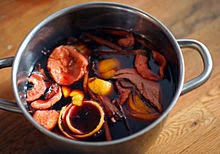
means to heat and spice. A mulled wine is usually created using a red wine,
Syrah or Zinfandel are good choices, as is a Port or claret. Then select
spices, like cinnamon, cloves, nutmeg, allspice, anise, cardamom, citrus, even
vanilla, along with sugar or honey for additional sweetening. Fruits
such as raisins, apples, and figs, even cranberries can be added along
with vodka, rum, sherry or brandy for an added kick. Top it off with a cinnamon
stick for stirring, and you have a mulled wine.
“Mulled”
means to heat and spice. A mulled wine is usually created using a red wine,
Syrah or Zinfandel are good choices, as is a Port or claret. Then select
spices, like cinnamon, cloves, nutmeg, allspice, anise, cardamom, citrus, even
vanilla, along with sugar or honey for additional sweetening. Fruits
such as raisins, apples, and figs, even cranberries can be added along
with vodka, rum, sherry or brandy for an added kick. Top it off with a cinnamon
stick for stirring, and you have a mulled wine.



 The British embraced mulled wine after Charles
Dickens touted it as the traditional holiday drink in A Christmas Carol.
In Victorian England Negus was a take on mulled wine using Port, spices, sugar,
and water. Negus was extremely popular, and was even served to children at
special celebrations.
The British embraced mulled wine after Charles
Dickens touted it as the traditional holiday drink in A Christmas Carol.
In Victorian England Negus was a take on mulled wine using Port, spices, sugar,
and water. Negus was extremely popular, and was even served to children at
special celebrations. 
 In the U.S. mulled wine is also a holiday favorite.
We tend to mix the ingredients together, place everything in a crockpot turned on
low, and let it simmer. That way a mulled glass of wine is always ready, whether you’ve been shoveling snow, decorating the Christmas tree, or
addressing holiday cards – cause you never know when that urge to hibernate and
stare into a fire will overtake you at this time of year - and you should
always be prepared.
In the U.S. mulled wine is also a holiday favorite.
We tend to mix the ingredients together, place everything in a crockpot turned on
low, and let it simmer. That way a mulled glass of wine is always ready, whether you’ve been shoveling snow, decorating the Christmas tree, or
addressing holiday cards – cause you never know when that urge to hibernate and
stare into a fire will overtake you at this time of year - and you should
always be prepared.


