Showing posts with label New Years Eve. Show all posts

Wednesday, December 23, 2015

Celebrating National Champagne Day and New Year's Eve


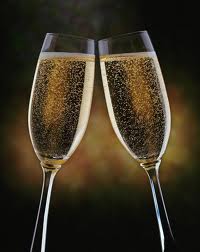
Let us raise a glass of Champagne this New Year’s Eve, not just to ring in the New Year, but to also celebrate National Champagne Day! It's the perfect time to pop that cork and enjoy a cascade of bubbles.

Drinking Champagne at celebrations began in the royal courts of Europe during the late 18th Century. In fact, Champagne has always been viewed as a drink of the rich; a type of vino status symbol.

Although Dom Perignon is usually credited with the invention of Champagne (and “drinking the stars”), it wasn’t until the 19th Century that the traditional method of riddling Champagne was discovered and used reliably.

This is also when the sweetness levels of wine began to be selected. Champagne went from doux (sweet), to demi-sec (half dry), to sec (dry). Extra sec (extra dry) describes a wine with even less sugar, and brute (extra brute) is made without sugar. Extra sec is the style that the majority of Champagne is crafted in.

Vines Destroyed by Phylloxera
During the 1860’s, the Great French Wine Blight occurred. Caused by an aphid from North America, the phylloxera epidemic ravaged vineyards throughout France; over 40% of the grape vines were destroyed within a 15-year period, from the late 1850’s to the mid 1870’s. Only after grafting aphid-resistant American grape vines onto the French vines was the devastation stopped.

Champagne, as we know it, came close to disappearing during the 20th Century. Two world wars almost destroyed the Champagne vineyards, and the Russian Revolution, Prohibition, and the Great Depression closed off two of the most lucrative markets for Champagne sales in the world. But the world rebounded in 1950, and sales of Champagne has risen steadily ever since.  

Today, over 250 million bottles of Champagne are produced in France each year. The British alone enjoy over 30 million bottles of Champagne – more than anyone else in the world.

And keep in mind, Champagne is only produced in the Champagne region of France, all other bubbly wines must go by the name “Sparkling Wine.

We pour Champagne to commemorate everything, from the launch of a ship, to the joining of two lives in marriage. We use it to celebrate life events, religious occasions, and joyous celebrations. Champagne not only imparts a feeling of joyousness and wonder to an occasion, it’s also a symbol of our approval and admiration for what we are celebrating.

So this New Year’s Eve when you raise that glass of dancing bubbles to toast the New Year, remember the words of the Wine Avenger, Willie Gluckstern;

“In a perfect world, everyone would have a glass of Champagne every evening.”

Indeed!
Here's to a perfect New Year!

~ Joy

Wednesday, December 26, 2012

Ring in the New Year “Drinking the Stars”


Next Monday is New Year’s Eve.  It’s a time to look back fondly over the past year, and anticipate the coming of the new.  And what better way to mark the celebration than with the pop of the cork and a cascade of bubbles – a glass of Champagne in hand.


But why do we choose this bubbly wine for our special moments?  It seems that drinking Champagne at celebrations began in the royal courts of Europe during the late 18th Century.  Champagne has always been viewed as a drink of the rich, a luxury, a status symbol.

In 987, when Hugh Capet was crowned King of France, he had the local wine served at the coronation banquets. This wine, made from Pinot Noir, was a pale pink without bubbles. But it began a local tradition of serving the Champagne region’s wines for celebrations. 


During the mid-17th century, Charles de Saint Evremond decreed to serve only the wines of the Champagne region at his London parties and banquets.  His taste influenced some of the most fashionable men of London.  Soon, Champagne was being ordered from France and shipped throughout England.  It was during the shipping, that the wine could restart the fermentation process. If it did, when the wine was opened, it was bubbly.  The English loved it, and began seeking out those “sparkling Champagnes.”  But the French winemakers were at a loss on how to control the process of making the wine sparkle.


In 1715, Philippe II, Duke of Orleans, enjoyed a sparkling version of Champagne nightly. Paris’s fashionable society followed the Duke’s example and sought out the bubbly version of the wine, making it a favorite among the French nobility.  It was during the 18th century that Champagne houses began to dominate over the vineyard owners.  The houses of Louis Roederer, Piper-Heidsieck, Taittinger and Moet & Chandon were founded during this time, creating a new type of business.  But at the end of the 18th century, over 90% of the Champagne region’s wine production was still the non-sparkling wines.


Although Dom Perignon is usually credited with the invention of sparkling Champagne, it wasn’t until the 19th Century that the methode champenoise, the traditional method of making Champagne, involving riddling, was used reliably.


It was also during this time that the sweetness level of the wine could be selected. Champagne went from doux or sweet, to demi-sec or half dry, to sec or dry.  Extra sec or extra dry described a wine with even less sugar, and brute or extra brute was made without sugar. Extra dry is now the style that the majority of Champagne is made in.


Then during the 1860’s, the Great French Wine Blight occurred. Caused by an aphid from North America, the phylloxera epidemic ravaged vineyards throughout France. Over 40% of grape vines were destroyed in a 15-year period, from the late 1850’s to the mid 1870’s.  Only after grafting the French vines with the aphid-resistant American grape vines, was the devastation stopped.


With the Twentieth Century came more misfortune, and could have brought about the demise of Champagne. Two world wars almost destroyed Champagne production; vineyards were devastated by war. The Russian Revolution, Prohibition, and the Great Depression closed two of the most lucrative markets for Champagne sales in the world.  But since 1950, sales of Champagne have risen steadily. 

Today, over 250 million bottles of Champagne are produced in France each year.  The British alone enjoy over 30 million bottles of Champagne – more than anyone else in the world.


Champagne is, indeed, a celebratory wine.  It is used to commemorate everything, from the launch of a ship, to the joining of two lives in marriage.  We use it to celebrate life events, religious occasions, and joyous celebrations.  Champagne not only imparts a feeling of joyousness and wonder to an occasion, it’s also a symbol of our approval and admiration for what we are celebrating.

So this New Year’s Eve, when you raise that glass of dancing bubbles to toast the New Year, remember the words of the Wine Avenger, Willie Gluckstern;


“In a perfect world, everyone would have a glass of Champagne every evening.”


Hmmm…..What an enjoyable resolution for 2013!

A safe and Happy New Year to you and yours!

~ Joy